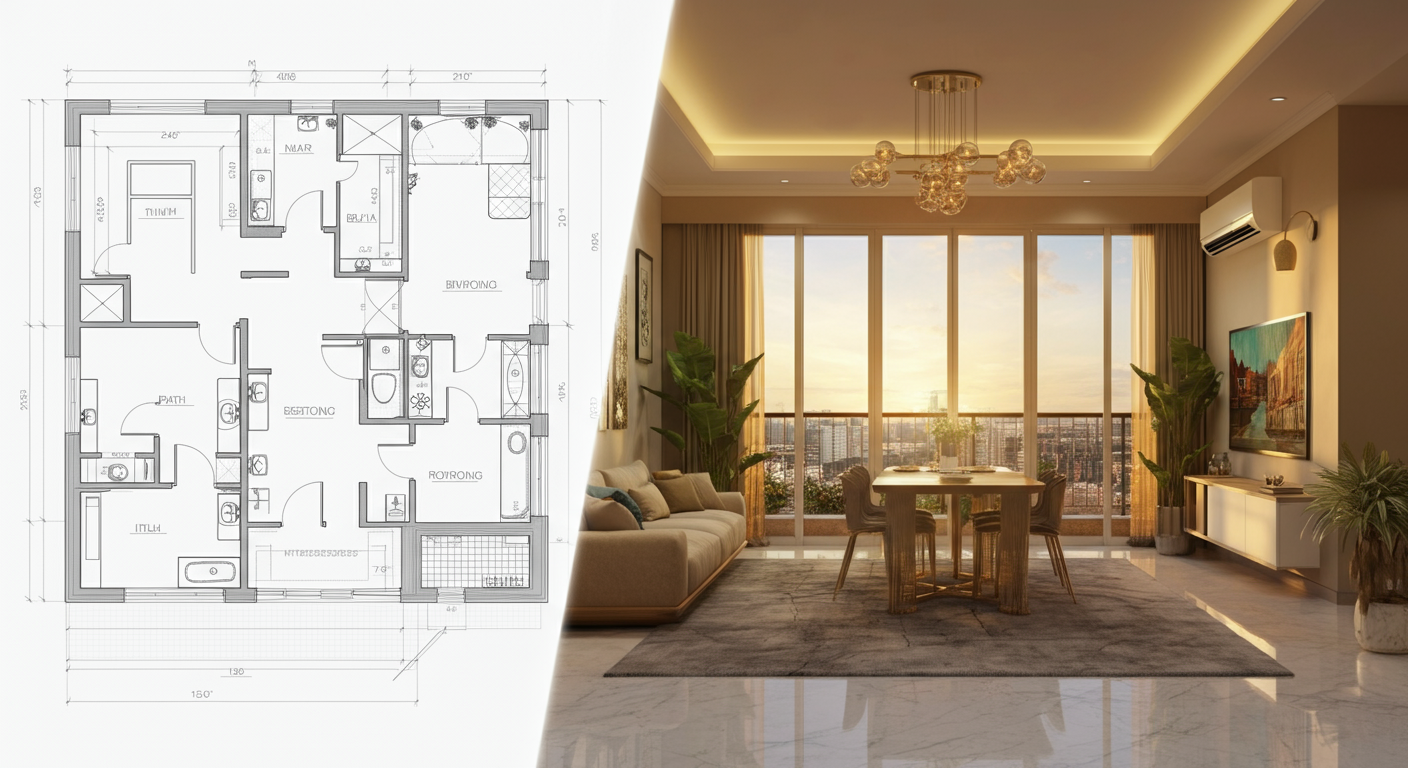
A broker enters an office space on a Tuesday morning. The space is everything that she could hope for, 60,000 square feet of prime real estate in the middle of the financial district. But her prospect lives halfway across the world in Singapore. And it's already 10 o'clock. For the last three weeks, she has been working with him on signing a 10-year lease valued at $8 million. He has made up his mind, but he wants to see it. To actually see it. Not through a static presentation in a PDF file. Not in a short phone call. He has to go there himself, place his staff's desks, imagine how his conference room will reflect the skyline of the city. He has to be sure that this space will do before he signs a lease for ten years.
Twenty years ago, she would have suggested that he flew down for that. Now, she logs him into her browser and shows him the space in real-time. She measures sight lines with him, checks the placement of columns, and demonstrates how daylight will flow through the floor. No flying required. He commits within 24 hours.
It is not science fiction. This is how business real estate operates today using digital twins and 3D visualizations that are changing the way leases are done. The changes are just starting to accelerate.
The Speed Advantage: Time is the New Real Estate Currency
Commercial real estate has been governed by one unchangeable rule: seeing is closing. One would need to see the property in person. That involved scheduling clashes, time on the road, expensive site visits for several stakeholders, and weeks of haggling until something got done. Each delay translated into another month of the property being empty. Each month of emptiness translated into hundreds of thousands of dollars down the drain.
The data tells an unforgiving tale. Industry studies show that the average time between first showing interest in a commercial property and signing on the dotted line is 4-6 months. The average annual vacancy cost for a 60,000-square-foot office block in a large urban area is $30-$40 per square foot. That means each month wasted represents $150,000-$200,000 in missed revenue.
That is precisely where digital transformation offers an entirely new business model.
With 3D tours available to anyone, anywhere, at any time, the whole sales process is streamlined. Someone in London can take a look at a building in Mumbai at midnight. An architecture team can conduct a study on how spaces interact without needing to leave their office. An investor can compare several different properties located in various countries in one afternoon.
But mere speed is not the full story. The issue is one of informed speed – when the customer moves faster due to confidence, rather than speed achieved by stripping away friction. Digital twins achieve both.
Building Trust in a Virtual World
What isn't discussed in commercial real estate is “Doubt”. Most commercial deals fall apart not because the deal itself doesn't make sense, but because buyers and investors simply can't overcome their doubts.
These doubts cause hesitation. Hesitation stretches out time. Time stretches create opportunities for prospects to find other options, lose board approvals, or change plans completely.
With a 3D digital twin, you can eliminate this entire category of doubts by trading imagination for facts. Your tenant can see precisely how 300 employees will navigate your facility. Your tenant can confirm your ceiling heights accommodate their machinery. Your tenant can confirm your loading dock is strategically placed based on their logistical needs. You aren't guessing anymore, you're verifying.
Imagination vs. verification creates a significant difference in the buying process. Your CFO can verify square footage utilization. Your operations team can verify workflow efficiencies. Your architect can measure and confirm against his/her/their blueprints.
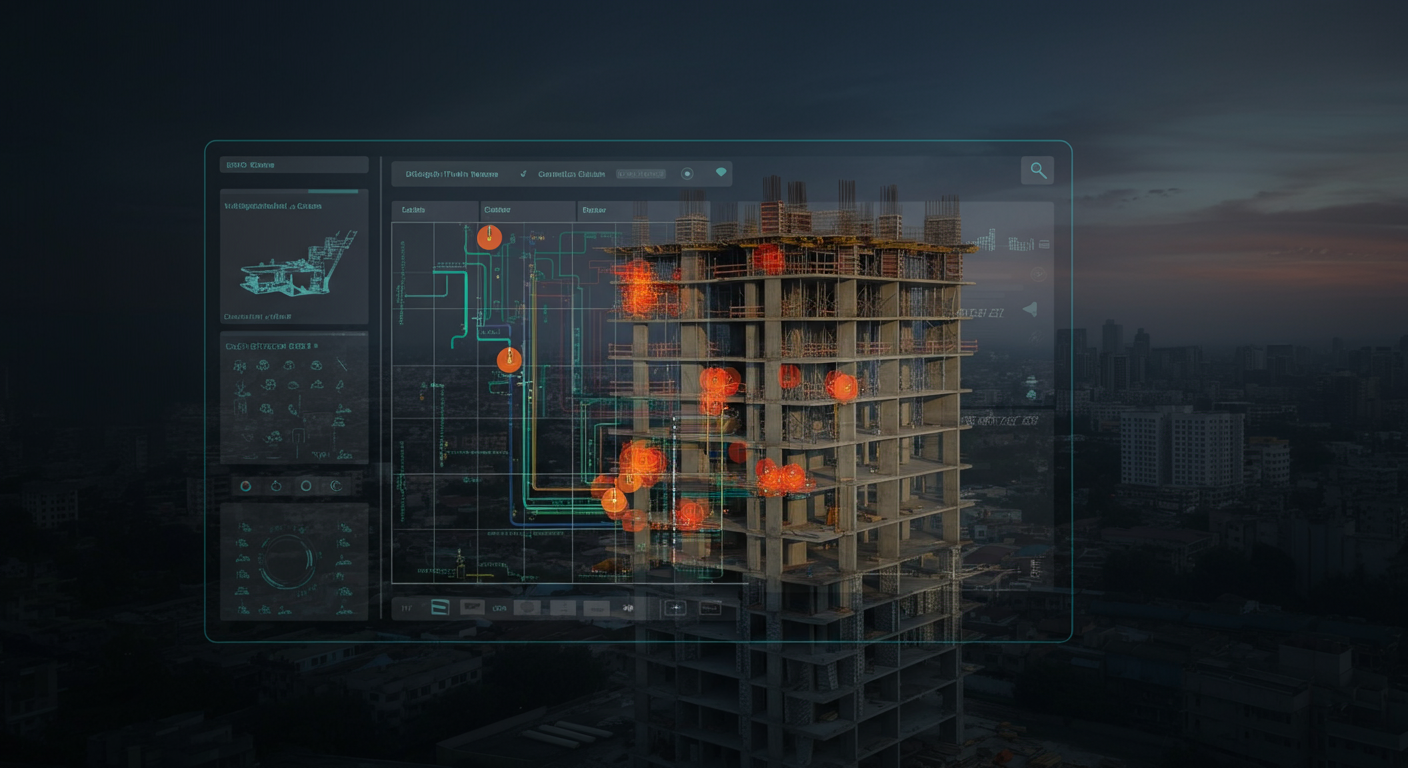
This is taken even further by SolidTwin, which brings interactive 3D architecture visualization together with real-time data regarding the performance of the environment. In effect, this means that brokers are now able to show clients not only the space itself, but also its performance capabilities. For example, natural lighting patterns during various times of the day; how energy efficiency metrics stack up against average values; and how climate control works.
This approach of bringing hard facts and verifiable information into the negotiation process becomes especially important when considering long-term agreements and commitments. Indeed, tenants who are willing to lease space in the building for several years ahead do not simply rent office furniture and walls. They invest in the future by ensuring that the location meets all necessary criteria, which helps avoid disappointments later on.
From Marketing Collateral to Sales Tool
Throughout the long history of real estate, 3D visualization has been an add-on for marketing, a pretty piece of work that could enhance your website or presentation but was essentially decorative.
This paradigm has changed radically.
The modern digital twin isn't just a pretty picture. It's an operational tool that helps make decisions. It isn't a rendering, it's a simulation. It isn't a presentation, it's a plan. Your tenant's architect can import dimensional information right into their CAD program. Your contractor can price out the job using precise room dimensions. Your facilities manager can plot out equipment layout even before you move in.
It turns out that when you use digital twins to make decisions, you make better decisions. They're quicker decisions. They're safer decisions. They're decisions that stick.
What this means for developers and real estate agents is that the technology provides an opportunity to generate results rather than just impressions. Properties that have been marketed using the 3D experience sell quicker and are more convincing about their price points. According to research conducted by JLL, 3D video properties are twice as likely to generate interest from buyers compared to properties that are advertised using regular floor plans.
The Commercial Real Estate Paradox: Global and Hyperlocal
In modern CRE, there's an interesting dichotomy: the market has become global, while decisions are still highly localized. It's possible to have corporate headquarters in New York and simultaneously evaluate property options in Toronto, Singapore, and Dubai. International investors must be able to analyze portfolios in different countries and different time zones. Architectural companies are cooperating with their partners across the world in the development of projects that may take several years to come to fruition.
Traditional site visits can't adapt to such conditions. The decision-maker would have to spend all of his time traveling if he needed to visit each property under consideration personally.
The concept of digital twins can serve as a way to resolve such a paradox. An investor from Hong Kong will now be able to inspect Mumbai properties as well as his local counterparts. Architects spread out across three continents will be able to work on a joint project in one and the same virtual space based on a 3D model. Working remotely from different locations has become a necessity, and even a competitive advantage, in our days.
It will even change the game for emerging countries as well. An Indian property developer can now exhibit its properties to institutional investors globally without having to go through the trouble of visiting each other. It makes the investment landscape fairer because there will be no information gap among investors anymore.
Performance Intelligence: The Next Layer
This is the point where the concept of digital twin extends beyond simple visualization to environmental intelligence.
A building is not just a physical structure, but a system with its own energy performance indicators, climate management systems, patterns of occupancy flows, and sustainability parameters. Smart buildings produce vast amounts of data on the way the building operates. What is missing in the story is to make such data useful for decision-making.
Incorporating environmental intelligence into 3D visualization opens the door to new opportunities. Showing energy efficiency, lighting patterns, air quality measurements, thermal performance metrics, and many other indicators will make the space intelligible in terms relevant for commercial purposes. A tenant focused on sustainability can ensure that the HVAC system will help maintain carbon footprint goals. A team involved in the operations can verify the patterns of occupancy flows, making sure the space is conducive to their work. A facilities manager can create a maintenance strategy based on factual data. It is time when the CRE market matures beyond mere transactions to optimize operations.
The Competitive Moat: Early Adoption
Time value has always been an important component in the real estate market, with faster marketing resulting in the quicker sale. Faster action from developers results in quicker market presence compared to that of any potential competitors. The combination of time value with the use of digital technologies makes for an even greater advantage.
By creating an engaging 3D tour with built-in environmental intelligence, the developer gets a significant conversion boost, resulting in more successful deals being closed at better conditions because prospects make up their minds faster and there is no information asymmetry anymore. The use of such technology helps the developer advance its entire selling process by days or even weeks, which constitutes a major competitive advantage in a business that runs on time.
Moreover, using such technology provides the developer or broker with another kind of benefit – namely, data collection. Every click made by prospects while interacting with the virtual property, every metric collected, every piece of information gathered from the client – everything goes into the database and allows the company to fine-tune the offering further on.
In terms of digital twins for CRE professionals, it is essential for the year 2026 onwards. This has become the bare minimum for competing in the market. Organizations that have been successful in implementing such technology have created an edge over other companies.
The Trust Equation in Virtual Space
The logical problem that occurs when talking about digital representation is – what if a place looks perfect on the 3D presentation, but once the prospect visits it – it turns out to be not that perfect?
However, there lies a misconception about modern digital twins technology. The platforms like SolidTwin do not embellish anything. It relies on real architectural drawings, real measurement of the dimensions, real environmental parameters. The digital representation is not prettier than reality because it is not more polished than the quick view of the location that one may do during the regular inspection.
On the contrary, such virtual representations bring people to reality with confidence. If a prospect spends an hour exploring and questioning the digital twin of the location, once they visit the real place, they make sure that everything is fine there. And if they were confident enough during the digital exploration, nothing could shake their decision.
Therefore, using digital representations, developers and brokers solve the problem of misinterpretation. Once the prospects know everything about a building, they will be much easier convinced of buying it.
Beyond 2026: What's Coming Next
The digital revolution of commercial real estate is still in its initial phases. The current wave of innovation caters to the basic requirement: making intelligent decisions without physically visiting the property. However, there is no doubt about the future path ahead: the integration of AI, predictive analysis, and autonomous optimization will intensify within the next five to ten years.
The next iteration of digital twin technologies will be able to predict how a property will work for certain applications. Algorithms powered by millions of buildings will highlight design flaws, recommend operational efficiencies, and predict long-term costs based on real-life building performance. Users will move from explore this building to optimize your operation in this building.
In today's context, the business model is quite simple: buildings offering immersive data-driven digital experiences will win against other properties. The marketplace will value transparency, efficiency, and certainty. Companies providing these capabilities early will create competitive advantages that will stand the test of time.
The Future is Now, Just Distributed
The question of how commercial real estate will become digital in the future seems like an interesting prediction. Actually, the future is already here; it's just that the distribution is uneven.
Leading developers, top brokers, billion dollar property investment firms, they have all adapted themselves to this new world and are using digital twins, collecting data and closing better deals more quickly. The benefits from speed and knowledge accumulate and compound for those who are prepared for the change.
However, the rest of the market has not yet adopted the new paradigm. Hundreds of thousands of smaller and medium properties depend on paper listings, 2D floor plans and actual visits in order to explain their potential and value.
There is a clear way forward for forward-thinking developers and brokers; the tools are ready, the market direction is evident.
It’s just a matter of whether you’ll be the leader or the follower.
The Singapore prospect who signed on the dotted line in 24 hours? He’s already spreading the word to his network about the process. He’s already referring the broker to other prospects. He’s already setting the precedent that this is how things are done when making real estate decisions. Prospects will demand it next time.
The future of commercial real estate is not coming. It’s already being created, one immersive 3D experience at a time.